Miscellaneous items #007My brain becomes full!
The limited capacity of our mental "working space"
A fascinating psychological phenomenon has become apparent while I have been learning Croatian with Mateja at SpeakCro.
Of course, Mateja has been helping me to accumulate vocabulary, to learn some grammar, and to become somewhat conversational - to the point where I can get by speaking Croatian on the streets of Split, Zagreb, or Zagvozd. I’m getting to be really, really good … “Molim vas, Gdje je kolodvor?”, “Želio bih produženu kavu, hvala.” “Izgubio sam se. Znaš li gdje je moj hotel? Ma ne, ne znam kako se zove.” Pretty much top level stuff ………..
But in my conversations with waiters, friends, policemen and judges, I have become aware that my biggest weakness is listening – understanding what others are saying. I might sort of get the drift of what a waiter has said (Želite li jelovnik, ili znate li što hoćete? “Would you like a menu, or do you know what you want?”), but by the time I process the details, with my screwed-up goofy face on, I find that he has moved on to the next table! So in some of our lessons, of course we converse in Croatian, but also Mateja reads to me from some Croatian texts. In particular, lately we have chosen a book Slonica koja je izgubila sreću. 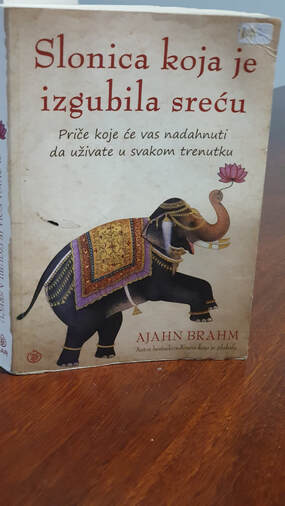
This book has been translated from English. Literally: "The elephant which has lost its happiness". although I think that the original English language version is entitled "Don't worry, be grumpy". By the way, the author is a Buddhist monk, Ajahn Brahm, who lives in Perth, just up the road a little from where I live. The text in this book is relatively simple linguistically, but the stories are quite profound in meaning. I strongly recommend it – either just as a good read and a vehicle for thinking, or for learning Croatian.
The phenomenon that has embarrassed me time and time again goes like this …
Mateja reads to me a sentence of moderate length. Yes, I pretty much understand it, but to translate it in detail into English, I need to think about a particular word near the end of the sentence, or to understand whether the boy gave it to the girl, or the girl gave it to the boy (yes, word endings, remembering that Croatians have seemingly no rules for word order), or ……. . OK, I sort that out . But then do you think that I can recall the first part of the sentence!? Ponovite, molim vas, Mateja!
By way of example, let’s just take the first two sentences from the story Priča o dva seljaka koji su uzgajali kokoši ………….. [A story about two villagers who were chicken breeders]
which you can find on a website in which three of the stories are reproduced: https://narancablog.com/2015/07/20/slonica-koja-je-izgubila-srecu-ajahn-brahm/ Bila jednom dva uzgajivača kokoši. Prvi je ustajao ranom zorom, uzimao košaru i polazio u kokošinjac kako bi pokupio ono što su koke tijekom noći proizvele. "Oh yeah, that’s not too demanding. I understood it, and I can translate it into English, Mateja".
But then my mind goes into analysis mode. In the next 3 seconds, my mind churns over the following …. That word koke. It looks like it is feminine plural, so the nominative singular would be koka. I’ve never heard of a word koka. But just from the context I suppose that it is an informal (slang?) word for kokoš? And proizvele? I don't know that. I guess it is the feminine plural past participle of a verb .. er, er, .......proizvesti? Hmmm ... I don't know that verb, but it reminds me of the noun proizvod (production). So it makes sense that su proizvele means “they (koke) produced”? Yes, feminine plural ending - le on the past participle. Well, that all seems to make sense. So now I will translate the whole text to Mateja. Hmmmm ...... 
Do you think that I can recall the first sentence, and the first part of the second sentence!? No idea at all!
It happens again, and again, and again. I have found it so embarrassing! And frustrating, and even exhausting. Why am I so stupid? Why doesn’t this happen when I listen to a long text in English?
But then Mateja pointed out this phenomenon is very common among her students.
Well that was some consolation. And I guess because I felt less embarrassed, I thought a little about why there might be a psychological barrier in my pathway to the first part of the sentence. And I recalled from somewhere in my past that there is strong evidence that when we are learning new stuff, our minds can only deal with about five “bits” of information (variable from person to person, but not many more, nor many less).
Do you want a very simple demonstration of this? Here is a mental task:
Read to someone (or have them read to you) a series of numbers, each from 0 to 9. The task for that person is as follows. After you have read out all of the numbers, mentally reverse the order of the numbers, and then write them down from left to right. For example, you read out the numbers 3, 8, 2. After they have heard all of the numbers, they do the mental reversal, and write, from left to right, 2, 8, 3. Then give progressively longer sequences. For example (but you can make up your own): 4, 6, 3, 8 (After which, they should write, from left to right 8, 3, 6, 4 9, 1, 4, 7, 6 5, 0, 8, 6, 9, 3 7, 3, 0, 6, 8, 3, 4 Very few people are able to do this task if there are more than five numbers. The task gives us more bits of information than the “working space” of our minds can deal with. The term used for this situation is “information overload”. The “working space” is full, and cannot bring into it other knowledge that is lurking somewhere in a dark compartment of our brain.
So when I was pondering upon koke and su proizvele, I filled up my mental “working space” and there was no room for the content of the early part of the text into that space. Search my mind as I might, it was locked out!
Does this surely oversimplified model of what’s happening make sense? I find it useful. Of course, as I become more proficient in the Croatian language, perhaps I won’t need to ponder upon the meaning of koke and su proizvele (for example), and my mental “working space” willnot be filled. That would allow me to access my memory of the early part of the text – just as though I were listening to some text in my native language. In other words, stuff that fills the “working space” for someone learning Croatian, might just flow straight through in the case of someone more proficient in the language. Nice story … Well, it makes me feel a little less stupid!
And then I began to think about what this means for my own profession – teaching chemistry at university.
Despite the fact that I say things SO, SO, clearly in lectures, the ignoramuses (ignoramii?) demonstrate in tests such shallow understanding and gross misconceptions. What’s wrong with them!? [Don’t tell them that I am aware that most of them are more intelligent than I am.]
Well, this has got me thinking. Here is a sentence, taken randomly from our textbook, that I might have said in a lecture – ever so carefully and ever so clearly, of course.
“Chemical species cannot be harmful to plants unless they are bioavailable. Copper ions in aqueous solution are bioavailable. Although small amounts of copper ions are necessary for the healthy growth of plants, high concentrations in soils, near mine sites for example, can be toxic to plants.” This is pretty standard stuff for a chemist. But I can imagine my student Marija hearing me say this in a lecture and perhaps pondering on any of a number of things to clarify the meaning …. Chemical species? What does that mean? Is that like species of plants and animals? Copper irons? What the …!? Bioability … is that what he said? What’s is that? Concentration? Like … paying attention? Toxic? Copper ions near mine sites? Why would that be? Yes, she mis-heard a few things, as novices do. That creates stuff to fill the "working space". Although Marija is very intelligent, if any of such questions flick through her mind at the time of hearing this sentence – and remember that I am already going on to say something else technical – although she mightn’t realise it, her brain is full (Well, the “working space” of her brain is full), and she is unable to make good sense of what I said.
Isn’t it interesting how learning Croatian can make me more conscious of the demands of teaching chemistry!
Fine. One tiny remaining challenge: What to do about it!?
Getting around
You can browse or search this website in the following ways:
AHA! Learning Croatian with Bob
Correspondence: [email protected]
0 Comments
Leave a Reply. |